

The Mid-Year Question That Matters: Are Your People Actually Taking Care of Themselves?

Here’s the uncomfortable truth most employers are avoiding halfway through 2026: your wellness program doesn’t matter if your people aren’t accessing basic preventive care.
Perhaps you’ve invested in health screenings, fitness reimbursements, and wellness apps. Maybe you promoted a “know your numbers” campaign or made an annual health risk assessment tool available. At a minimum, you’ve likely helped your people remember the importance of annual physicals and reminded them that your plan covers preventive care at 100%.
But when was the last time you actually looked at preventive care utilization rates?
Many employers have quietly abandoned traditional wellness programs over the past few years. The pivot makes sense. Why spend money on programs with 10-20% participation when the fundamental problem is simpler: your employees aren’t seeing doctors, aren’t getting screenings, and aren’t catching health issues before they become expensive crises.
The market has shifted from “how do we incentivize wellness?” to “how do we remove the barriers preventing people from taking care of themselves?” That’s a fundamentally different question. And it requires fundamentally different solutions.
The Primary Care Crisis You’re Paying For
Here’s what the data tells us: 130 million Americans live in areas with a primary care shortage. Another 150 million live in mental health shortage areas. Even among employees with commercial insurance, access to quality primary care is inconsistent at best. But access isn’t the only problem. It’s time. It’s convenient. It’s cost. It’s trust.
Your employees know they should have a relationship with a primary care physician. In some cases, your plan may even require them to designate a PCP. They know they should get annual physicals. They know they should follow up on that elevated blood pressure or abnormal lab result. They know they should address the anxiety or depression that’s affecting their work.
But between work demands, family obligations, and the friction of scheduling appointments weeks out, taking time off, sitting in waiting rooms, and paying copays, preventive care keeps getting pushed to tomorrow. And tomorrow becomes next month. And next month becomes a crisis that lands them in the ER or results in a late-stage diagnosis that could have been prevented.
Even as I write this, I’m the first to acknowledge my own struggles. HUB incentivizes us to get an annual physical, but to make that happen by the deadline, I have to schedule my appointment up to 10 months in advance. When I had skin cancer, it took over a year and three separate dermatologist visits to get a correct diagnosis. Sometimes, good intentions are not enough.
The question at mid-year isn’t whether your wellness program is working. The question is whether your people are taking care of themselves. And if they’re not, what barriers are you willing to remove?
Question 1: Are Your People Accessing Preventive Care?
Pull your claims data from 2025, or if available from January through June 2026. Look at preventive care completion rates:
• Annual physicals: What percentage of your eligible employees completed an annual physical in the first half of the year? If you’re below 40%, you have a problem. National benchmarks suggest 46% completion for health assessments and screenings, but best-in-class employers are pushing 60-70%.
• Cancer screenings: Are age-eligible employees completing mammograms, colonoscopies, and other recommended screenings? These are covered at 100% under preventive care provisions, yet completion rates remain frustratingly low.
• Chronic condition management: For employees with diagnosed diabetes, hypertension, or cardiovascular disease, are they seeing providers regularly? Are they getting lab work done? Are medications being refilled consistently? Are you able to see information on gaps in care?
• Mental health engagement: With 86% of companies increasing mental health investment but only 23% of employees actively using resources, the gap is massive. Are your employees accessing therapy, counseling, or psychiatric care?
If the answer to these questions is “I don’t know,” that’s your first problem. If the answer is “yes, but the numbers are low,” your second problem is understanding why.
The most common barriers to preventive care include:
Access: Can’t get an appointment for weeks or months.
Time: Taking half a day off work feels impossible.
Cost: Even with insurance, copays and deductibles add up. Even though preventive care may be covered, some people fear getting bad news and the likelihood of additional costs later.
Convenience: Scheduling, commuting, parking, waiting rooms.
Trust: Don’t have an established relationship with a provider they trust.
These aren’t excuses. There are systemic barriers that traditional healthcare models haven’t solved.
Question 2: Are Early Interventions Catching Issues Before They Escalate?
The point of preventive care isn’t just checking boxes. It’s catching health issues early when they’re manageable and inexpensive to treat. Look at your claims patterns from the first half of 2026:
• Are chronic conditions being diagnosed earlier? When employees are diagnosed with diabetes, hypertension, or heart disease, are they Stage 1 or Stage 3? Early diagnosis means lower severity and lower costs.
• Are biometric trends improving? For employees who completed health screenings in 2025 and 2026, are the numbers moving in the right direction? Weight, blood pressure, cholesterol, and glucose. If you catch issues early and provide support, you should see measurable improvements.
• Are medication adherence rates high? Employees with chronic conditions should consistently refill their prescriptions. If adherence is below 80%, either access or engagement is a problem.
• Are ER visits for chronic conditions declining? Diabetic employees shouldn’t be landing in the ER for blood sugar crises. Hypertensive employees shouldn’t be showing up with cardiovascular emergencies. If these are happening, your preventive care strategy isn’t working.
Research shows that 80% of patients who use comprehensive virtual primary care lower their blood pressure and stabilize their glucose after just five visits. That’s what early intervention looks like when access barriers are removed. In addition, you can reasonably expect that when large diagnoses do occur, they are being caught at Stage 1 instead of Stage 3, not only improving the health of the benefits program, but more importantly, the health and longevity of your people.
Question 3: Are Preventive Barriers Driving Reactive Costs?
This is where the financial impact becomes undeniable. Compare your first-half 2026 costs to first-half 2025 in these categories:
Emergency room visits for non-emergent conditions: We covered this in April’s newsletter on healthcare illiteracy. Are employees going to the ER at 11 PM because they don’t have access to timely primary care or virtual urgent care?
Late-stage diagnoses: Are you seeing new cancer diagnoses at Stage 3 or 4 that could have been caught earlier with routine screenings? Are heart attacks and strokes happening in employees with unmanaged hypertension?
Preventable hospitalizations: Are employees being admitted for complications from poorly managed diabetes, COPD, or heart failure? These are textbook examples of preventable costs driven by inadequate primary care.
Specialist overutilization: Without a primary care “front door,” employees often go straight to specialists or urgent care for issues that could be handled through primary care at a fraction of the cost.
If these costs are climbing, your preventive care access problem is translating directly to your renewal.
The Virtual Primary Care Solution
Here’s where many employers are finding traction: virtual primary care removes the barriers that traditional in-person care can’t solve.
Access? Virtual primary care appointments are available within 2-3 days, not weeks. Urgent issues? Same-day access. Mental health? Therapists available within 2-3 days.
Time? No commute, no waiting room, no half-day off work. Appointments start on time and happen from home, the office, or wherever employees are.
Cost? Most virtual primary care models operate on a per-employee per-month fee with $0 copays for employees. Visits don’t generate claims, which means they don’t drive up plan costs.
Convenience? Access via app, website, or phone. Schedule when it works for you. Connect with the same provider over time to build continuity.
Trust? Employees work with the same board-certified primary care physician, building a relationship over time rather than seeing whoever’s available.
Programs like First Stop Health have demonstrated that this model works at scale. With 45% utilization rates (industry-leading compared to 30-35% average for traditional wellness programs), 93% of visits rated 5 stars, and measurable outcomes like 80% of patients lowering blood pressure after five visits, this isn’t theoretical. It’s happening.
Virtual primary care isn’t a replacement for in-person care. It’s a complement. For routine preventive visits, chronic disease management, mental health support, and urgent care needs, virtual care removes friction. When in-person care is needed, specialists, imaging, or procedures, the virtual provider coordinates referrals to in-network, high-quality providers.
This is the “front door” to healthcare that traditional models never provided.
What Good Looks Like at Mid-Year
If your people are actually taking care of themselves, here’s what you should see by June:
Preventive care rates are climbing. More employees are completing physicals, screenings, and routine check-ups than in the first half of 2025.
Chronic conditions are being managed proactively. Employees with diabetes, hypertension, and heart disease are seeing providers regularly, not just when crises happen.
Mental health is being addressed. Therapy and counseling utilization is up, not because problems are worse, but because stigma and access barriers are down.
Primary care has a clear “front door.” Employees know where to go when they need care, whether it’s virtual primary care, urgent care, or in-person specialists.
Reactive costs are declining. Fewer ER visits for non-emergent issues. Fewer late-stage diagnoses. Fewer preventable hospitalizations.
Mid-Year Course Corrections
If the answers to the three questions aren’t what you hoped, June is your opportunity to reset.
Low preventive care utilization? Consider adding virtual primary care to remove access barriers. Programs like First Stop Health operate on a per-employee per-month model with $0 copays, making adoption simple and cost-effective.
Poor chronic condition management? Virtual primary care with integrated health coaches, dietitians, and diabetes educators provides the ongoing support that episodic in-person visits can’t deliver.
Mental health underutilized? Virtual mental health removes the stigma and logistical barriers that prevent employees from seeking therapy. When access is easy and confidential, utilization increases.
No clear entry point to care? Traditional benefits are fragmented. Employees don’t know whether to call telemedicine, schedule urgent care, or go to the ER. A comprehensive virtual primary care program becomes the single front door, triaging and coordinating all care.
Three Questions for June
As you evaluate your mid-year health outcomes, three questions should guide your strategy:
If an employee needed care tonight, would they know where to go and be able to access it?
Are your people catching health issues early, or are you paying for late-stage crises?
What barriers are you willing to remove to make preventive care the default, not the exception?
The mid-year audit isn’t about measuring participation in the wellness program. It’s about measuring whether your people are taking care of themselves. And if they’re not, it’s about understanding why and removing those barriers before the second half of the year costs you even more. Wellness programs were never the answer. Access to quality, convenient, affordable primary care is.
The question is whether you’re ready to make it easy.
---
**Sources:**
First Stop Health, “Virtual Primary Care Solutions”
Shortlister, “First Stop Health Meet a Vendor Presentation”
Wellable, “120 Employee Wellness Statistics for 2026”
RAND Corporation, “Workplace Wellness Programs Study”
News You Can Use
Below are a select number of events and updates that you may be valuable:
HUB will be hosting a webinar titled “Breaking the Cost Cycle: Taking Control of Your Cost Strategy” on Wednesday, June 24th. Anchored in HUB’s 2026 Cost Management Report, this session brings together HUB experts across clinical, pharmacy analytics, and benefits analytics to translate data-driven research into clear, actionable guidance. Register Here.
The Business Case for Physical Wellbeing
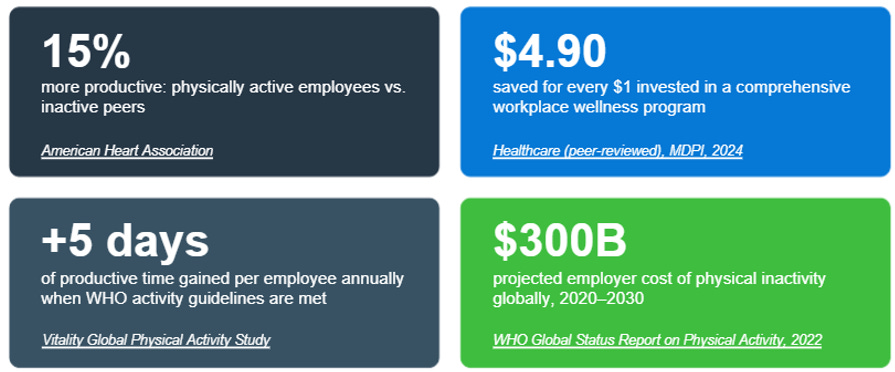
Organizations that invest in employee physical health see measurable returns: reduced healthcare spend, higher productivity, and stronger retention. The data speaks clearly:
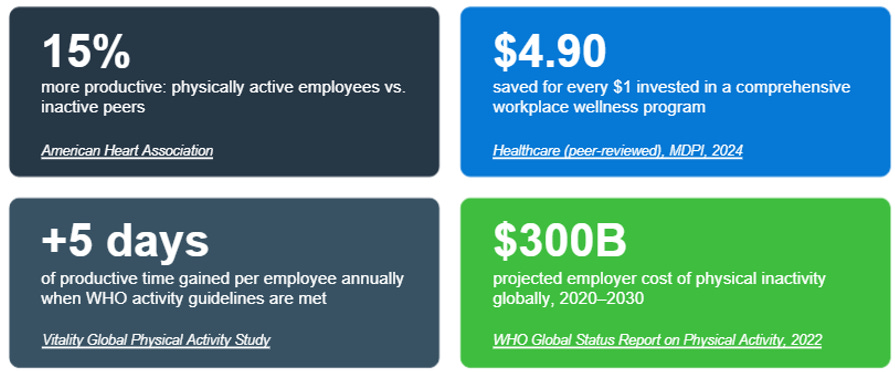
Investing in employee physical well-being is not a line item. It is a competitive advantage. It doesn’t have to be expensive or complex. HUB’s Health and Performance team is ready to help guide you. Just let me know if you’d like to schedule time with our experts.
Direct-to-Consumer (DTC) Pharmacy Programs can enhance your employees’ experience. Since DTC pharmacies sell medications directly to patients, your employees can access drugs at prices often 60-80% below retail. These options are ideal when a drug isn’t covered by your plan (i.e., most GLP-1 options for weight loss). DTC Pharmacy sites include:
TrumpRx: This government portal connects patients to manufacturer DTC sites and coupons available at pharmacies nationwide.
GoodRx: This drug discount card aggregator offers free coupons and a drug cost comparison tool. Savings vary.
Mark Cuban Cost Plus Drug Company: This DTC pharmacy offers transparent cost plus pricing on generic and biosimilar medications only
Manufacturer Offerings: Some manufacturers, such as LilyDirect and NovoCare, offer direct-to-patient programs with an eligible prescription. These programs generally allow medications to be filled through their mail-order model or in partnership with a national retail pharmacy.
Worth Sharing
Throughout this series of newsletters, we’ve spoken often about the power of health insurance captives. Increasingly, these programs are offering employers a chance to improve community, transparency, cost control, and sustainability.
On June 4th, I hosted a small event in Fort Collins where a couple of my clients spoke to the attendees about their own experiences in joining a captive.
It’s one thing for me to tout the benefits. It’s another thing to hear it directly from your peers. The conversation was powerful, and I want to say thank you to Austin and Tim for so graciously sharing their wisdom and experiences with others.
If we haven’t had this conversation, we should.
Captives are becoming a hot topic, and it’s likely you will hear more and more about them as an alternative to traditional markets in the coming years.
However, not all captives are created equally. We’ve covered this in past issues, and specifically in a focus piece published in March. You can check it out here.
It’s important that, at a minimum, you understand how many members are in the captive, how the stop loss terms protect you in the event of a bad year, and what, if anything, the captive is actively doing to ensure all members are implementing smart cost containment solutions.
Think of those three items as criteria. Some meet one. A few meet two. Only one existing captive program checks all three boxes.
Let me know if you’d like to learn more.
Enjoy your summer, and the celebration of the 250th anniversary of these United States.
Thank you,
Jim